Between 4 and 18 months, babies change faster than at almost any other time: from cooing and grabbing their toes to walking, pointing and saying their first words. Knowing the baby milestones to look for at each stage helps you notice progress, find the right kind of play, and know when a question is worth raising with your pediatrician.
The milestones below follow the checklists from the CDC’s “Learn the Signs. Act Early.” program, which describe skills most babies show by a given age. Use them as a friendly guide, not a scorecard.
- Movementrolling, sitting, walking
- Languagebabbles, gestures, words
- Socialsmiles, games, affection
- Thinkingexploring, problem-solving
How to use this baby milestones guide
Every baby develops at their own pace. Some walk early and talk later; others chatter away long before they take a step. A milestone checklist shows what most babies can do by a certain age, so it is normal for your baby to reach some skills sooner and others a bit later.
- Look at the overall pattern across movement, language, social and thinking skills.
- If your baby was born early, ask your pediatrician whether to use their adjusted age.
- Bring your observations and questions to every well-child visit.
The best way to support baby milestones is not drills or special equipment. It is everyday connection: talking and singing to your baby, reading together, giving plenty of safe floor time, and responding warmly when they reach out to you. The play ideas below fit easily into ordinary days.
Around 4 months
Your baby is waking up to the world and to you. They are awake for longer stretches, watch faces closely and are starting to discover their own hands. By about 4 months, many babies:
- Smile on their own to get your attention
- Coo and make sounds back when you talk
- Turn toward the sound of your voice
- Hold their head steady when held upright
- Bring hands to mouth and swing at toys
- Push up onto elbows during tummy time
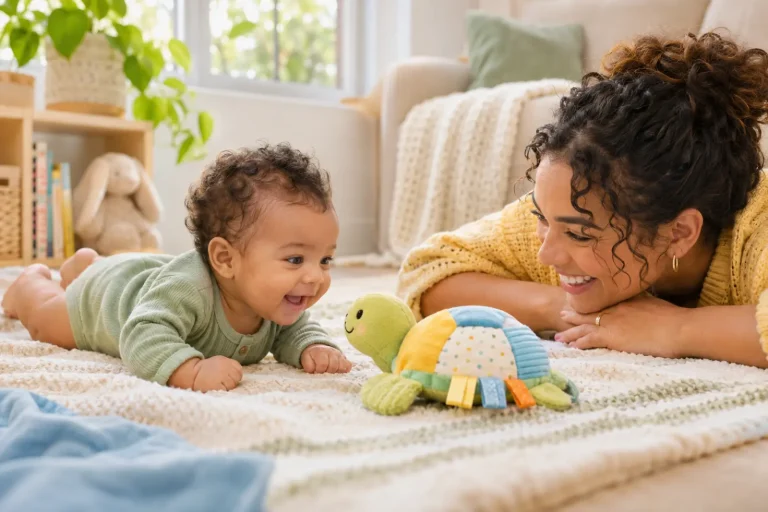
Have “conversations”: copy your baby’s coos, pause, and wait for a reply. Add short, supervised tummy time with a toy in view.
Our guide to tummy time by age has more ideas for building early strength.
Around 6 months
Now your baby is more social and much more mobile, and everything goes straight into the mouth, which is how babies explore. Around 6 months, many babies:
- Recognize familiar people
- Laugh, squeal and blow raspberries
- Take turns making sounds with you
- Reach to grab a toy they want
- Roll from tummy to back
- Lean on their hands for support when sitting
Offer a safe baby mirror, then name what your baby sees: “There’s your nose! There are your eyes!”
Around 9 months
This is often when stranger shyness appears, which is a sign of healthy attachment. You may also notice your baby reacts when you leave the room. Short, warm goodbyes and a happy return help them learn that you always come back. Around 9 months, many babies:
- Seem shy or clingy with new people
- Look when you call their name
- Babble sounds like “mamama” and “bababa”
- Lift arms up to be picked up
- Look for an object dropped out of sight
- Sit without support and get into sitting alone
Play peekaboo and hide a toy under a cloth while your baby watches, then cheer when they find it.
Around 12 months
The first birthday brings a burst of communication and movement. Your baby understands far more words than they can say, so keep naming objects, people and actions throughout the day. Around 12 months, many babies:
- Play games like pat-a-cake
- Wave bye-bye
- Call a parent “mama,” “dada” or another special name
- Understand “no” and pause
- Pull up to stand and walk holding furniture
- Pick up small things between thumb and finger
Offer a container and a few safe, large objects to drop in and dump out, again and again.
Around 15 and 18 months
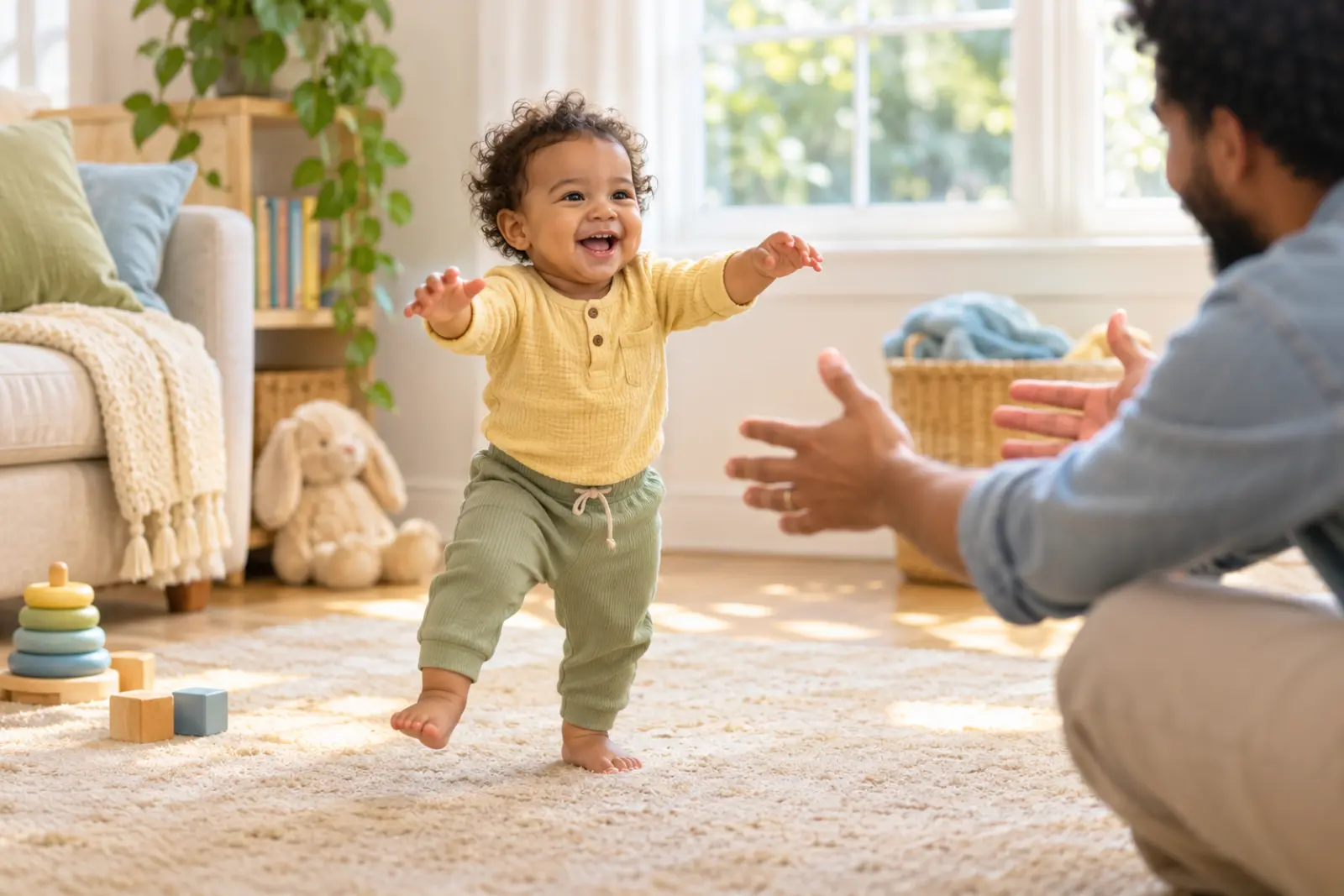
Your baby is becoming a toddler, with opinions to match. Expect more “no,” more exploring and more pride in doing things alone. Around 15 months, many babies take a few steps on their own, try to say one or two words besides “mama” or “dada,” point to ask for something, and copy other children while playing.
By about 18 months, many toddlers:
- Walk without holding on
- Try to say three or more words
- Follow one-step directions without gestures
- Point to show you something interesting
- Scribble and try to use a spoon
- Copy you doing chores, like sweeping
Read picture books together and pause to let your child point while you name each thing.
Words come fast from here. Our post on toddler language development shares easy ways to build vocabulary, and our toddler program picks up at 18 months with language, creative play and early self-help skills.
When to talk to your pediatrician
You know your baby best. The CDC encourages parents to act early when something seems off, rather than waiting to see. Reach out to your pediatrician if:
- Your baby is not showing several of the milestones for their age.
- Your baby loses skills they once had, at any age.
- You have a feeling something is not right, even if you cannot name it.
Your pediatrician can talk through your concerns, do a developmental screening and, if needed, point you toward support. In California, families can also ask about early intervention services for babies and toddlers. Asking early never hurts.
At Bright Learning Academy caregivers in our infant program celebrate every smile, reach and babble, and share them with families through daily photos, videos and progress reports, so you never miss a milestone.
Baby milestones: frequently asked questions
What if my baby is late on a milestone?
Babies develop at different speeds, and missing one milestone by a little is often not a concern on its own. Look at the bigger picture, keep offering playful practice, and mention it to your pediatrician, who can check in at your next visit.
When do most babies start walking?
Many babies take their first independent steps somewhere around their first birthday, and the CDC lists walking without holding on as a milestone by about 18 months. A wide range is normal.
When do babies say their first words?
Many babies say “mama” or “dada” as a name for a parent around 12 months and add a few more words by 15–18 months. Gestures like pointing and waving are important early communication too.
Are crawling milestones important?
Some babies crawl, some scoot or roll, and a few go straight to pulling up and walking. That is why the CDC checklists do not include crawling as a milestone. What matters is that your baby is finding ways to move and explore.
Growing together, milestone by milestone
Baby milestones are something to celebrate, not something to stress over. If you are looking for a caring infant room where your baby can explore, play and grow, come visit us in South San Francisco.
Every reach, babble and wobbly step matters.