Young children pick up new sounds and words with an ease that most adults can only envy. That’s why so many families look for a bilingual preschool, or at least a program with daily exposure to a second language. Spanish is a natural choice here in California, and the benefits go well beyond learning to count to diez.
Below are seven real benefits of learning Spanish early, the most common myths parents worry about, and a few easy words you can practice together at home, even if you don’t speak a word of Spanish yourself.
- 7 benefitsfor language, thinking and culture
- Play-basedsongs, games and stories
- No confusiontwo languages are a gift, not a burden
- Any familyno Spanish needed at home
Why early childhood is a great time to learn a language
In the first years of life, children are wired to listen closely to the sounds around them. They hear and imitate new sounds readily, they aren’t self-conscious about making mistakes, and they learn language the same way they learn everything else: through play, songs and everyday routines.
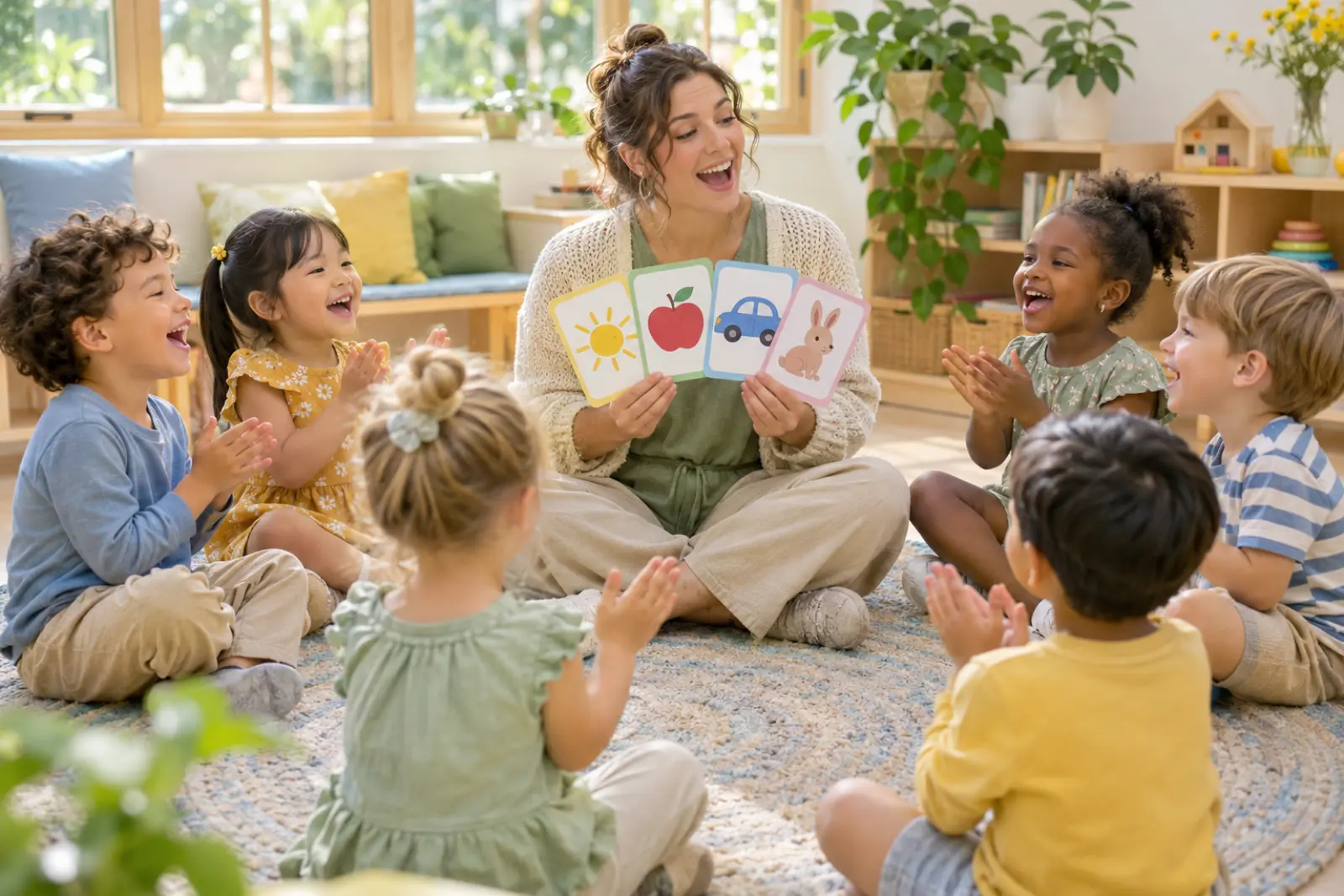
That doesn’t mean it’s ever “too late” to learn Spanish. But in the preschool years, a second language can be absorbed naturally, with no textbooks or vocabulary tests, just as part of the day. A good bilingual preschool makes the most of this window by weaving the second language into songs, routines and play rather than formal lessons.
7 benefits of a bilingual preschool
1. A natural accent
Children who hear a language early often pronounce it more like a native speaker. Rolling an r in “perro” or saying “gracias” the way it’s really said comes much more easily at three than at thirty.
2. More flexible thinking
Switching between two ways of naming the same thing, like “blue” and “azul,” asks a young brain to pay attention, notice context and shift gears. Some research suggests bilingual children may get extra practice in these thinking skills, which also help with problem solving and focus.
3. Stronger language awareness
Learning a second language helps children notice that words are made of sounds and that the same idea can be said in different ways. That kind of awareness supports the pre-reading skills children need for English too, like rhyming and hearing beginning sounds.
4. Curiosity about other cultures
Songs, stories and celebrations from Spanish-speaking countries open a window onto the wider world. Children learn early that people live, eat, play and talk in many different ways, which builds empathy and respect.
5. Connection with the community
Spanish is spoken all around the Bay Area: at the park, in shops, at the doctor’s office and in many families. Even a few words help children connect with neighbors, classmates, caregivers and sometimes their own grandparents.
6. More options later on
Many California school districts offer dual-language or Spanish immersion programs, and Spanish is a common world language choice in later grades. Early exposure gives your child a head start and a familiar, positive feeling about the language.
7. Confidence and joy in learning
There’s real pride in teaching your parents a new word. Children who succeed at learning a language early often come to see themselves as capable learners, a feeling that carries into every subject.
Common myths about learning two languages
Myth: Two languages will confuse my child
Young children are very capable of keeping two languages apart. Mixing words from both languages in one sentence, sometimes called code-switching, is a normal part of bilingual development, not a sign of confusion.
Myth: A second language will delay speech
Mainstream guidance, including from the American Academy of Pediatrics, is that learning two languages does not cause language delays. Bilingual children reach their language milestones within the typical range. Our guide to toddler language development explains what’s typical and when to check in.
Myth: It only works if parents speak Spanish
Not at all. In a bilingual preschool, children learn a great deal from regular, playful exposure during the school day. Your interest and encouragement at home matter far more than your own fluency.
If you have concerns about your child’s speech in any language, talk to your pediatrician. A good evaluation looks at both languages together.
How Spanish immersion works in our classrooms
Every age group at Bright Learning Academy has a dedicated Spanish immersion block every day. It’s active and playful, built around four things young children love:
- Counting and numbers
- Colors and shapes
- Songs and games
- Stories and early reading
Babies hear songs and simple words, toddlers start joining in, and preschoolers count, name colors and shapes, and begin early reading with Spanish songs and stories. No prior Spanish is needed, for children or for parents.
At Bright Learning Academy Spanish immersion is part of the Education pillar of our N.I.C.E. framework, alongside early literacy, math and world cultures. See how it fits into the full day in our curriculum, or learn more about our school and approach.
Easy Spanish words to practice at home
You don’t need to be fluent to keep Spanish going at home. Pick two or three words a week and use them in everyday moments: counting stairs, naming colors at snack time, saying “¡Hola!” at pickup.
| English | Spanish | Say it like |
|---|---|---|
| Hello | Hola | OH-lah |
| Thank you | Gracias | GRAH-see-ahs |
| Please | Por favor | por fah-VOR |
| One, two, three | Uno, dos, tres | OO-noh, dohs, trehs |
| Red | Rojo | ROH-hoh |
| Blue | Azul | ah-SOOL |
| Yellow | Amarillo | ah-mah-REE-yoh |
| Circle | Círculo | SEER-koo-loh |
| Square | Cuadrado | kwah-DRAH-doh |
| Water | Agua | AH-gwah |
| Friend | Amigo / amiga | ah-MEE-goh / ah-MEE-gah |
A few more ways to keep it fun:
Let your child be the teacher. Asking “How do you say ‘water’ in Spanish?” gives them a proud moment and a little extra practice.
Frequently asked questions
Is a bilingual preschool good for my child?
For most children, yes. Early, playful exposure to a second language supports pronunciation, language awareness and cultural curiosity, and it does not slow down English development. The best fit is a warm, play-based program your child enjoys.
Will learning Spanish confuse my child or delay English?
No. Learning two languages does not cause language delays, and mixing words from both languages is a normal stage. If you have any concerns about your child’s speech, talk to your pediatrician.
Do I need to speak Spanish to support my child?
No. Show interest, ask your child to teach you words, sing along and borrow bilingual books. Your encouragement matters more than your fluency.
What is the best age to start learning a second language?
Children can start benefiting from exposure as babies, and the preschool years are an especially natural time to learn through songs and play. That said, it’s never too late to start.
¡Hola! Come say hello
A second language is one of the most joyful gifts you can give a young child. If you’d like to hear our Spanish songs, counting games and stories in action, we’d love to welcome you for a visit.
Uno, dos, tres: let’s learn together.