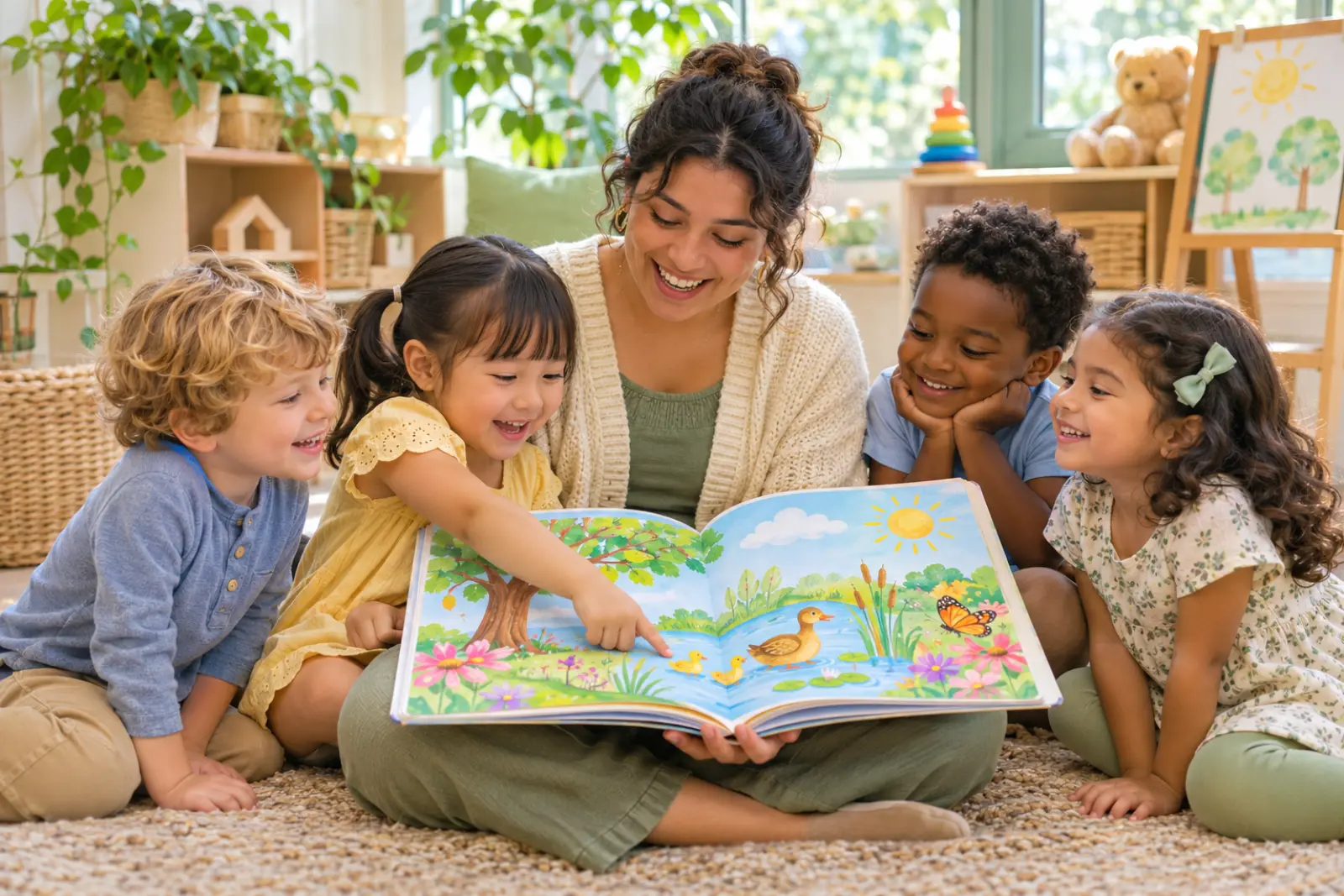
Long before children read their first word, they’re quietly building the skills that make reading possible. These pre-reading skills include hearing the sounds in words, knowing how books work, recognizing letters and loving stories. The good news is that you build them with simple, playful moments you probably already share with your child every day.
Here’s what early literacy really involves, eight easy ways to support it at home, and why there’s no need to rush your preschooler into reading.
- 6 skillsthe foundation for reading
- Every dayread aloud together
- Play firstno flashcards needed
- No rushreading comes in its own time
What are pre-reading skills?
Pre-reading skills, sometimes called early literacy skills, are the abilities children develop before they can decode words on a page. Researchers and educators group them in slightly different ways, but most lists include these six:
| Skill | What it means | What it looks like |
|---|---|---|
| Print awareness | Knowing that print carries meaning and how books work | Holding a book right side up, turning pages, pointing to words |
| Phonological awareness | Hearing and playing with the sounds in spoken words | Noticing rhymes, clapping syllables, hearing that “ball” starts with /b/ |
| Vocabulary | Knowing the names of things, actions and feelings | Using new words from books in everyday talk |
| Letter knowledge | Recognizing letters and learning that they stand for sounds | Spotting the first letter of their name on a sign |
| Narrative skills | Understanding and telling stories | Retelling what happened in a book or at the park |
| Love of books | Enjoying stories and wanting to read | Bringing you a book and asking for “one more” |
Notice that only one of these is about letters. Most early literacy is about listening, talking and enjoying stories together.
8 simple ways to build pre-reading skills
1. Read aloud every day
Daily read-alouds are the single most useful habit for early literacy. Choose books with rich pictures and interesting words, and let your child pick favorites, even if that means the same book for the tenth night in a row. Repetition is how children learn new words and start to anticipate what comes next.
2. Play rhyme games
Sing nursery rhymes, read rhyming books and pause before the last word so your child can fill it in. Make up silly rhymes in the car: “cat, hat, bat… zat!” Nonsense words count. Hearing rhymes is an early step in phonological awareness.
3. Clap the syllables
Clap out the beats in names and everyday words. It turns listening into a game your child can feel:
4. Point to the print
Now and then, run your finger under the words as you read a title or a short line. Point out print in the world too: stop signs, cereal boxes, store names. Your child learns that we read left to right and top to bottom, and that those marks stand for words.
5. Go on letter hunts
Start with the letters in your child’s name, which are usually the most exciting ones. Look for them on signs, mail and packaging, or hide magnetic letters around a room. Keep it light: a game, not a quiz.
6. Retell stories together
After a book, ask, “What happened first? Then what?” Act the story out with stuffed animals or puppets. Talking about real events helps too: “Tell Grandma what we saw at the beach.” Retelling builds memory, sequencing and narrative skills.
7. Make writing part of play
Leave crayons, chalk and paper where your child plays. Scribbles and “pretend writing” are real steps toward writing. Invite them to “write” a grocery list, a birthday card or a menu for a pretend café, and ask them to read it to you.
8. Make the library a habit
Regular library visits keep fresh books coming and let your child choose for themselves. Many public libraries also run free story times for little ones, which add songs, rhymes and a room full of other young readers.
What early literacy looks like by age
Every child develops at their own pace, so think of these as general patterns rather than deadlines.
- Toddlers (about 18 months–3 years) enjoy short books, point to and name pictures, and join in on familiar words and songs. This stage is mostly about talking, so our guide to toddler language development is a great companion.
- Three-year-olds often recognize a few letters, especially in their own name, enjoy rhymes and can retell parts of a favorite story.
- Four- and five-year-olds typically recognize many letters, start linking some letters to their sounds, notice rhymes and beginning sounds, and may write a few letters, often starting with their name.
For a fuller picture of what helps children start school confidently, see our kindergarten readiness checklist, which covers early literacy alongside social, math and self-care skills.
Why there’s no need to rush reading
Some preschoolers start reading words early, and many don’t until kindergarten or first grade. Both are normal. Pushing early reading with drills can make books feel like work, while a child who loves stories and has strong pre-reading skills is set up well for the moment formal reading instruction begins.
The goal in preschool isn’t a child who reads. It’s a child who can’t wait to learn how.
That said, trust your instincts. If your child seems to have trouble hearing, rarely uses new words, or has a hard time following simple directions, talk to your pediatrician. Early support for hearing or speech makes a real difference.
At Bright Learning Academy early literacy is woven through the day with phonological awareness games, concepts of print, sign language, songs and plenty of children’s literature. In our preschool program, children also work on letter recognition, storytelling and writing readiness. Explore how it all fits together in our curriculum.
Frequently asked questions
What are the most important pre-reading skills?
Most educators point to print awareness, phonological awareness, vocabulary, letter knowledge, narrative skills and a love of books. Phonological awareness, hearing and playing with sounds in words, is especially helpful once children begin learning to read.
At what age should my child know the alphabet?
It varies widely. Many children recognize a handful of letters by age 3 and learn most of them during the pre-K and kindergarten years. Focus on playful exposure rather than a deadline, and mention any concerns at your child’s regular checkups.
Should I teach my preschooler to read?
You don’t need to. If your child is curious and asking about words, follow their lead happily. Otherwise, reading aloud, rhyming and talking together build the foundations that make formal reading easier later.
What is the difference between phonological and phonemic awareness?
Phonological awareness is the broad ability to hear sounds in spoken language, such as rhymes and syllables. Phonemic awareness is one part of it: hearing the individual sounds within a word, like the three sounds /k/ /a/ /t/ in “cat.”
Growing readers, one story at a time
A daily book, a silly rhyme, a letter spotted on a sign: small moments like these add up to a confident early reader. If you’d like to see how our teachers build early literacy through songs, stories and play, come visit our classrooms.
Every great reader starts with a great story.