“Is my child ready for preschool?” is one of the most common questions we hear from parents of two- and three-year-olds. The honest answer is that readiness has very little to do with reciting the alphabet or counting to twenty. It is about how your child handles everyday things: a few hours away from you, a simple instruction, a turn with a toy, a busy room full of other kids.
Below are 10 signs to look for, grouped into four areas, plus what to do if your child is only partway there. Spoiler: most children are, and that is completely normal.
- Independencesmall self-care steps
- Communicationsharing needs in words
- Socialcurious about other kids
- Routinesfocus and transitions
What preschool readiness really means
Many parents assume a child needs to know letters, numbers and colors before starting preschool. In reality, those are the things preschool teaches. What helps a child settle in is a set of everyday skills that let them feel comfortable and capable in a group. So when you ask yourself “is my child ready for preschool?”, think about daily life rather than flashcards.
Readiness is less about what your child knows and more about how they cope, connect and communicate.
It also helps to know what kind of program you are looking at. Preschool usually has a more structured learning day than a mixed-age childcare setting. If you are still weighing your options, our guide to the difference between daycare and preschool walks through it.
Signs 1–3: growing independence
1. They can spend time apart from you
Your child may still cry at goodbye, and that is fine. The sign to watch for is whether they can settle and enjoy themselves after you leave, perhaps with a grandparent, a sitter or at a playgroup.
2. They are trying simple self-care
Washing hands with help, pulling on shoes, eating a snack without being fed, putting a cup on the table. Your child does not need to master these, but showing interest in doing things “by myself” is a great sign.
3. They are aware of bathroom needs
Some preschools require children to be fully potty trained, while others support children who are still learning. If your child is starting to notice a wet diaper or tell you they need to go, that is progress worth celebrating. Our potty training tips cover how to tell when your toddler is ready.
Signs 4–5: communication
4. They can tell an adult what they need
Can your child let someone other than you know they are hungry, thirsty, hurt or need the bathroom? Words, short phrases and gestures all count. Teachers learn each child’s way of communicating quickly, but some ability to ask for help makes the first weeks easier.
5. They follow simple directions
Instructions like “Put your shoes by the door” or “Get your cup and sit down” are part of every preschool day. A child who can follow a one- or two-step direction, at least some of the time, is ready for group routines like clean-up and circle time.
Signs 6–8: social and emotional
6. They are curious about other children
Watching other kids at the park, playing next to them, copying what they do: these are the early steps toward friendship. Full cooperative play comes later, often during the preschool years themselves.
7. They can wait, with help
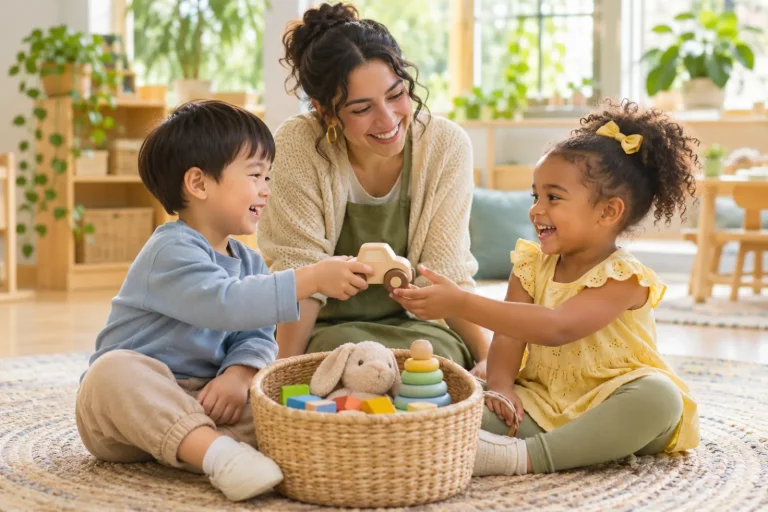
Taking turns is hard for young children. If your child can wait a short moment for a turn on the slide when an adult guides them, they are building the patience a classroom needs.
8. They are starting to manage big feelings
Meltdowns still happen at this age. What matters is that your child can be comforted and recover, and is beginning to use words for feelings. Signs you might notice:
Signs 9–10: attention and routines
9. They can focus for a few minutes
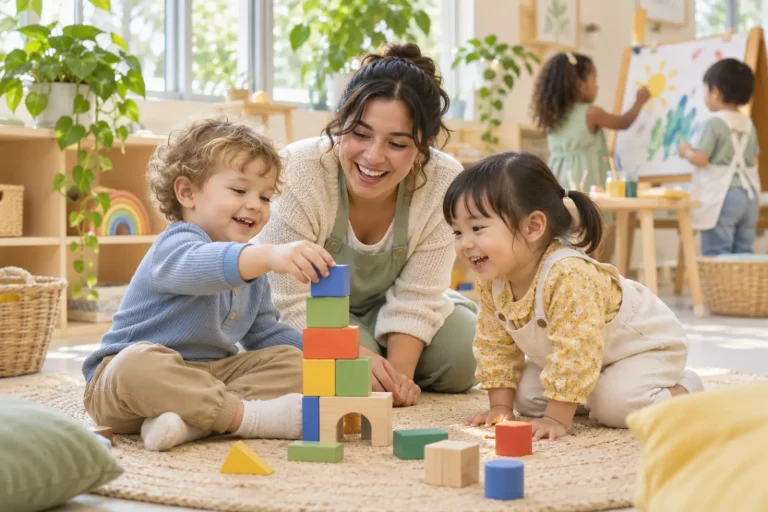
Sitting through a short story, finishing a simple puzzle or playing with blocks for a stretch shows growing attention. Nobody expects a three-year-old to sit still for long; preschool activities are designed to be short and hands-on.
10. They handle a daily rhythm
A preschool day moves from play to snack to outdoor time to rest. Children who are used to a predictable routine at home, with regular mealtimes and naps, usually adjust to a school schedule more easily.
What if my child isn’t ready for preschool yet?
If you read this list and thought “some of these, not all,” you are in good company. Very few children tick every box before day one. These skills grow fastest in a group setting, with caring teachers modeling and coaching them every day.
- Practice short separations with trusted adults before school starts.
- Let your child try self-care tasks, even when it takes longer.
- Read books about starting school and talk about what a day will look like.
- Arrange playdates or park visits so your child is around other kids.
- Share any concerns with the teachers; they want to know your child.
If you have concerns about your child’s speech, behavior or development beyond normal variation, talk to your pediatrician. They can help you decide on next steps and the right timing.
At Bright Learning Academy our preschool program welcomes children ages 3–6 and builds independence through classroom jobs, self-help routines and potty training support with positive reinforcement. Teachers meet children where they are.
Is my child ready for preschool? A quick checklist
Tick off what you already see at home. Anything left unticked is simply something to practice.
All ten ticked — your child sounds ready for a new adventure!
Preschool readiness: frequently asked questions
What age should a child start preschool?
Most children start preschool between ages 3 and 4, though programs vary. Age is only part of the picture. Your child’s comfort with separation, communication and group routines matters just as much.
Does my child need to know letters and numbers before preschool?
No. Letters, numbers, colors and shapes are what preschool teaches. Social, emotional and self-care skills are more helpful starting points. Later, our kindergarten readiness checklist shows how those early skills build toward the next big step.
Does my child have to be potty trained to start preschool?
It depends on the program. Some require it; others, including ours, support children who are still learning. Ask each school about its policy when you tour.
Is my child ready for preschool, or should we wait a year?
Look at the overall pattern rather than any single skill. If your child is curious, can cope with short separations and communicates basic needs, they are likely ready with support. If you are unsure, talk to the teachers at your top-choice school and to your pediatrician.
See if preschool feels right for your child
The best way to answer “is my child ready for preschool?” is often to watch them in a real classroom. Bring your child for a visit, meet our teachers and see how a day unfolds in our South San Francisco preschool.
Every child gets ready in their own time. We’re here to help with each step.